
The Reserve Bank of India (RBI) is set to introduce polymer banknotes to address the rising demand for currency, improve durability, and reduce production costs, with a pilot project expected soon.

Reserve Bank Deputy Governor S C Murmu has highlighted the "cash paradox" where currency in circulation continues to grow despite a significant increase in digital payments. This trend complicates the RBI's forecasting and planning for currency production and distribution, prompting the central bank to seek solutions and explore ways to extend banknote life and reduce the carbon footprint of the cash cycle.

RBI says polymer notes have a significantly longer lifespan, potentially reducing printing costs and replacement frequency.

Punjab Police has dismantled the financial infrastructure of drug-trafficking networks, freezing assets worth Rs 300 crore linked to alleged drug smugglers.
State-owned Engineers India and MECON as well as four private entities are in the fray for the project to comprehensively revamp RBI's currency management infrastructure in order to cater to future cash needs of the country's fast growing economy. The four private entities are: Accenture Solutions; Colliers International (India) Property Services; PricewaterhouseCoopers and The Boston Consulting Group (India).

Filling of Rs 100 and Rs 200 notes result in faster depletion and more frequent cash replenishment. This will cost banks and managed service providers more.

The 557th meeting of the Central Board was chaired by RBI Governor Raghuram Rajan, and attended by the four deputy governors among others

People can send their Rs 2,000 banknotes to specified regional offices of the Reserve Bank through the insured post for credit in their bank accounts. This is a hassle-free option for the people who are away from the regional offices of the Reserve Bank. Besides, the RBI is offering TLR (Triple Lock Receptacle) form to people for a deposit of Rs 2,000 banknotes in their bank account.
The Delhi high court on Monday dismissed a public interest litigation (PIL) challenging the RBI's decision to withdraw Rs 2,000 denomination banknotes from circulation. A bench of Chief Justice Satish Chandra Sharma and Justice Subramonium Prasad, which had reserved its order on the PIL on May 30, rejected the plea. Petitioner Rajneesh Bhaskar Gupta has contended that the Reserve Bank of India (RBI) has no power to withdraw Rs 2,000 currency notes from circulation and only the Centre could have taken a decision in this regard.

The humble Rs 100 bill had several takers on an otherwise normal weekday evening across the country on Tuesday night, even as police had to be deployed outside ATMs to control the crowd waiting eagerly to get their hands on the banknote.

The Reserve Bank of India (RBI) on Tuesday told the Delhi high court that withdrawal of Rs 2000 notes is not demonetisation but a statutory exercise, and the decision to enable their exchange was taken for operational convenience.
A public interest litigation was filed in the Delhi high court on Monday against permission to exchange Rs 2000 banknotes without obtaining any requisition slip and identity proof.
The Reserve Bank of India on Thursday said banknotes in circulation witnessed higher than average increase during 2020-21, on account of precautionary holding of cash by people due to the COVID-19 pandemic, and its prolonged continuance. The value and volume of banknotes in circulation increased by 16.8 per cent and 7.2 per cent, respectively, during 2020-21, as against an increase of 14.7 per cent and 6.6 per cent, respectively, witnessed during 2019-20, said the RBI annual report. In value terms, the share of Rs 500 and Rs 2,000 banknotes together accounted for 85.7 per cent of the total value of banknotes in circulation as on March 31, 2021, as against 83.4 per cent as on March 31, 2020.

Any currency design change must be approved by the RBI central board and the central government.
It is only after the government's nod that a particular design change come into effect.
Reserve Bank Governor Shaktikanta Das on Thursday said about 50 per cent of Rs 2,000 notes in circulation has come back in the banking system since the RBI announced withdrawal of the highest denomination currency last month. As on March 31, 2023, he said, Rs 2,000 notes worth Rs 3.62 lakh crore were in circulation. "So far, Rs 1.80 lakh crore have come back after the announcement," he said during an interaction with media after releasing the bi-monthly monetary policy here.

The RBI was not party to the decision to demonetize 500 and 1,000-rupee notes, which was taken at the highest level of India's political leadership.
The Bharatiya Janata Party rejected this was any sort of demonetisation and instead reminded the Congress that even during the rule of Manmohan Singh, old currency notes were taken off circulation.

Reserve Bank Governor Shaktikanta Das on Wednesday said that RBI is monitoring the situation regularly with regard to the withdrawal of Rs 2,000 currency notes and expressed confidence that the entire exercise will be completed in a non-disruptive manner. The Reserve Bank of India (RBI) on Friday announced the withdrawal of Rs 2000 denomination banknotes as part of its currency management and permitted the exchange of Rs 2000 currency notes up to Rs 20,000 in one go from Tuesday onwards. The exchange or deposit window is available until September 30, 2023.

Amid uncertainties arising out of the second wave of COVID-19, the Reserve Bank on Thursday said that a durable revival of private consumption and investment would be critical for sustaining economic growth post-pandemic. Observing that 2020-21 has left a scar on the economy, RBI in its annual report said, "in the midst of the second wave as 2021-22 commences, pervasive despair is being lifted by cautious optimism built up by vaccination drives." The second wave of the pandemic has prompted revision of growth projections for the current fiscal and the consensus appears to be gravitating towards RBI's forecast of 10.5 per cent, the report added.

Small queues were witnessed at some bank branches on Tuesday for the exchange of Rs 2,000 notes against smaller denominations as part of the withdrawal exercise. As per the RBI guidelines issued on Friday, the exchange of Rs 2,000 facility is available from Tuesday. A person can exchange up to a limit of Rs 20,000 at a time without filling any form or requisition slip.

The Reserve Bank on Wednesday hiked key benchmark policy rate by 25 basis points to 6.5 per cent, citing sticky core inflation. This is the sixth time interest rate has been hiked by the Reserve Bank of India (RBI) since May last year, taking the total quantum of hike to 250 basis points. Announcing the bi-monthly monetary policy, RBI Governor Shaktikanta Das said the Monetary Policy Committee (MPC) by a majority decided to raise the policy repo rate by 25 basis points and keep a 'strong vigil' on inflation outlook.

Demonetisation of the high value currency notes of Rs 500 and Rs 1,000 did not have any discernible impact on currency in circulation (CIC) in the country, which has soared by almost 83 per cent since its announcement on November 8, 2016. The Supreme Court on Monday upheld the decision of the government on demonetisation. On November 8, 2016 Prime Minister Narendra Modi had announced demonetisation of old Rs 1,000 and Rs 500 banknotes and one of the key objectives of the unprecedented decision was to promote digital payments and curb black money flows.

If the high security notes introduced in 2015 were kept in the system, the pain due to demonetisation can be ameliorated to a certain extent. But unfortunately, such thought process have no place in the hasty demonetisation decision.

Despite the demonetisation of 2016 and the rise in digital transactions that followed, the economy's dependence on cash has remained as high as ever. So when the Reserve Bank of India (RBI) introduced a pilot project of its version of digital cash - called the central bank digital currency (CBDC) - on December 1, many questions were asked. Can the CBDC replace physical cash, even partially? Can it match cash in terms of convenience? Are CBDC transactions truly anonymous?
A representative of the Confederation of ATM Industry said ATM players were not consulted about the move and they received the news via media platforms.

The RBI refuses to classify a cryptocurrency as an asset since it doesn't have future cash flow and its value is always fluctuating because of speculation. There is also no consumer protection, observes Tamal Bandyopadhyay, and hence the e-rupee trial run.

According to its DRHP filed in 2010, the company's net worth was just Rs 140 crore. Its total income for the financial year 2009-10 stood at Rs 119 crore and it had a net profit of Rs 16 crore. In sharp contrast, at the end of March 2021, Paytm's networth was Rs 6,535 crore and total income stood at Rs 3,187 crore.

Jewellers sold huge quantities of precious ornaments at a premium of up to 50%.

In efforts to move towards a cashless society, the Reserve Bank on Wednesday said it will come out with a concept paper on promoting electronic payments, especially in smaller towns, by November-end.
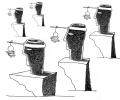
'This way, you'll maintain our glorious traditional values and get more efficient governance as well.'

ICICI bank waives ATM charges.

'Then why should people like us face this inconvenience?'

I kept insisting that Rs 100 notes were in short supply and there was an urgent need to augment the supply of 100 rupee notes while also rapidly bringing into circulation the proposed new Rs 500 notes. But this was easier said than done because all the note printing machines of the RBI were programmed for printing Rs 2,000 notes and required at least three weeks before the machines could print the new Rs 500 currency notes. The availability of currency paper posed another major bottleneck, and it had to be imported. It was decided to immediately start printing the Rs 500 notes. It was only when the supply of the new Rs 500 notes started improving and the process of change of cassettes at the ATMs gathered momentum that the situation began limping back to normal. A fascinating excerpt from former SBI chairman Rajnish Kumar's The Custodian of Trust: A Banker's Memoir, five years after demonetisation, November 8.

The official twists and turns have raised questions on the government's credibility and its ability to pull the nation out of the demonetisation quagmire. To keep up with the new rules, the government has issued an updated FAQ on demonetisation.

The Nikkei India Services Purchasing Managers' Index (PMI), which tracks services sector firms on a monthly basis, stood at 48.7 in January, as against 46.8 in December 2016.

The main factors contributing to the above-50.0 PMI reading were growth of both new orders and output as market conditions returned to normal and led to subsequent improvement in demand.

The Nikkei Markit India Manufacturing Purchasing Managers' Index (PMI) -- a gauge of manufacturing performance -- fell to 52.3, down from October's 22-month high of 54.4.
The specifics will also cover what's fit and proper to be a chest manager; the insurance and re-insurance aspects; and the new capital threshold, which is Rs 100 crore now.

A week after Prime Minister Narendra Modi announced that the Rs 500 and Rs 1,000 notes are illegal tender, at least 33 people have been reported dead in demonetisation-related incidents.
